
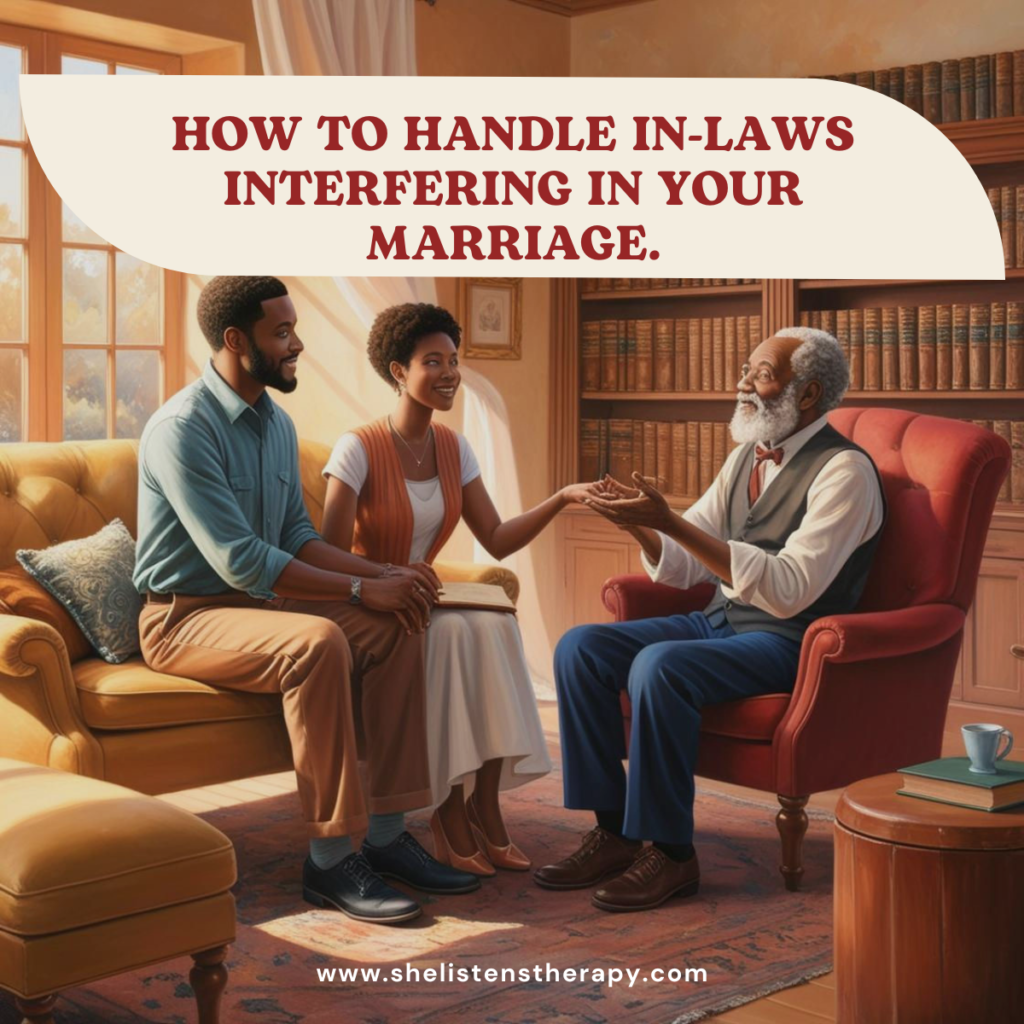
You did not just marry a person. You married into a family. And sometimes that family has a lot of opinions about how your marriage should be run.
What to eat. Where to live. When to have children. How to spend money. Who should be working. What your roles should look like. It starts small and then, before you realise it, you are making decisions in your own home based on what someone else thinks is best for your life.
In-law interference is one of the most common reasons couples fight. And one of the least talked about, because nobody wants to be seen as the person who caused a family problem.
But here is what nobody tells you. The problem is rarely just about the in-laws. It is about what happens between you and your partner when the pressure arrives.
Here are six honest things you need to understand and do.
Your spouse is the one who needs to set the boundary, not you
This is the most important point in this entire post. Read it again if you need to.
When your in-laws are interfering, it is not your job to confront them. It is your spouse’s job. It is their family. They are the bridge. And if they are not willing to be that bridge, the problem is not just your in-laws. It is also your marriage.
When a spouse allows their parents to disrespect, override, or undermine their partner and says nothing, they are making a choice. Silence is a choice. Keeping the peace with their family at the expense of their partner is a choice.
A united front starts with your spouse being willing to say to their family, clearly and respectfully, “This is my marriage and we handle things together.” Without that, nothing else you do will fully work.
Talk to your spouse first, always
Before you address anything with your in-laws, you and your spouse need to be on the same page. That conversation has to happen privately, calmly, and honestly.
Tell your partner specifically what is happening and how it is affecting you. Not as an attack on their family but as an honest conversation about your marriage. “When your mother makes decisions about our home without asking us, I feel like we are not being treated as adults” lands very differently from “your mother is always interfering and it is driving me mad.”
One invites your partner to work with you. The other puts them on the defensive immediately.
Your spouse cannot fix what they do not know is breaking you. Give them the chance to understand before you write them off as unsupportive.
Understand the difference between involvement and interference
Not everything your in-laws do is interference. Some of it is love expressed in ways that feel like too much. Some of it is cultural. Some of it is habit. Some of it is genuine care that has not learned where the lines are yet.
Interference is when someone’s involvement overrides your ability to make your own decisions as a couple. When their opinions become instructions. When their presence makes you feel like a guest in your own marriage.
Involvement is when family is present, supportive, and connected without controlling.
Knowing the difference matters because your response should be different. Not everything needs a confrontation. Some things need a gentle redirection. Others need a firm boundary. Learning to tell them apart will save you a lot of unnecessary conflict.
Set boundaries with love, not war
Boundaries with in-laws do not have to be hostile. In fact, the moment they become hostile, you make everything harder for your spouse and for yourself.
A boundary is not a wall. It is a clear communication of what works and what does not. It can be delivered with warmth. “We appreciate your input and we have decided to handle it this way” is a complete sentence. You do not need to justify it, argue it, or apologise for it.
The goal is not to cut your in-laws out. The goal is to protect your marriage while keeping the relationship as respectful as possible.
When boundaries are set from a place of strength and clarity rather than frustration and resentment, they are much easier to maintain and much easier for the other person to receive.
Do not make your spouse choose, but do not pretend you are okay when you are not
Telling your spouse “it is me or your family” is one of the most damaging things you can do. It puts them in an impossible position and almost always backfires.
But on the other side of that, swallowing everything and acting like it is fine when it is not is also slowly destroying you and your marriage. Suppressed resentment does not stay quiet forever. It builds and it comes out sideways, usually at the worst possible time.
The middle ground is this. Be honest about your experience without making your spouse feel like a criminal for having a family. Say what you need. Be specific. Ask for their partnership, not their abandonment of their loved ones.
You are not fighting against their family. You are fighting for your marriage. Keep that distinction clear, especially in the hard conversations.
Protect your home as a safe space
Your home is the foundation of your marriage. What happens inside it, the atmosphere, the decisions, the conversations, belongs to you and your spouse first.
This means being intentional about what you allow in. Information that does not need to leave your home should stay there. Complaints that will paint your spouse in a bad light to their family should be handled between the two of you. Details about your finances, your conflicts, your private life do not need to become family discussion topics.
It also means that when in-laws visit, there are still boundaries. Visits have time frames. Conversations have limits. Your space is yours even when it is shared.
A home that both partners feel safe in is a marriage that can withstand outside pressure. Guard that.
Final thoughts
In-law interference rarely ruins a marriage on its own. What ruins a marriage is two people who stop being a team when the pressure arrives.
Your in-laws are not your enemy. They are people who love your spouse and may not have fully understood where their role ends and yours begins. That can be navigated. It requires honesty, patience, and a spouse who is willing to show up for their marriage as much as they show up for their family.
If you are reading this and feeling alone in your marriage because your partner keeps choosing family peace over your wellbeing, that is a deeper conversation worth having. Not in anger. In honesty.
You married each other. That relationship deserves to be the priority. Protect it together or it will slowly be pulled apart by everything around it.
A strong marriage is the best thing you can give your family, including the one you married into.