
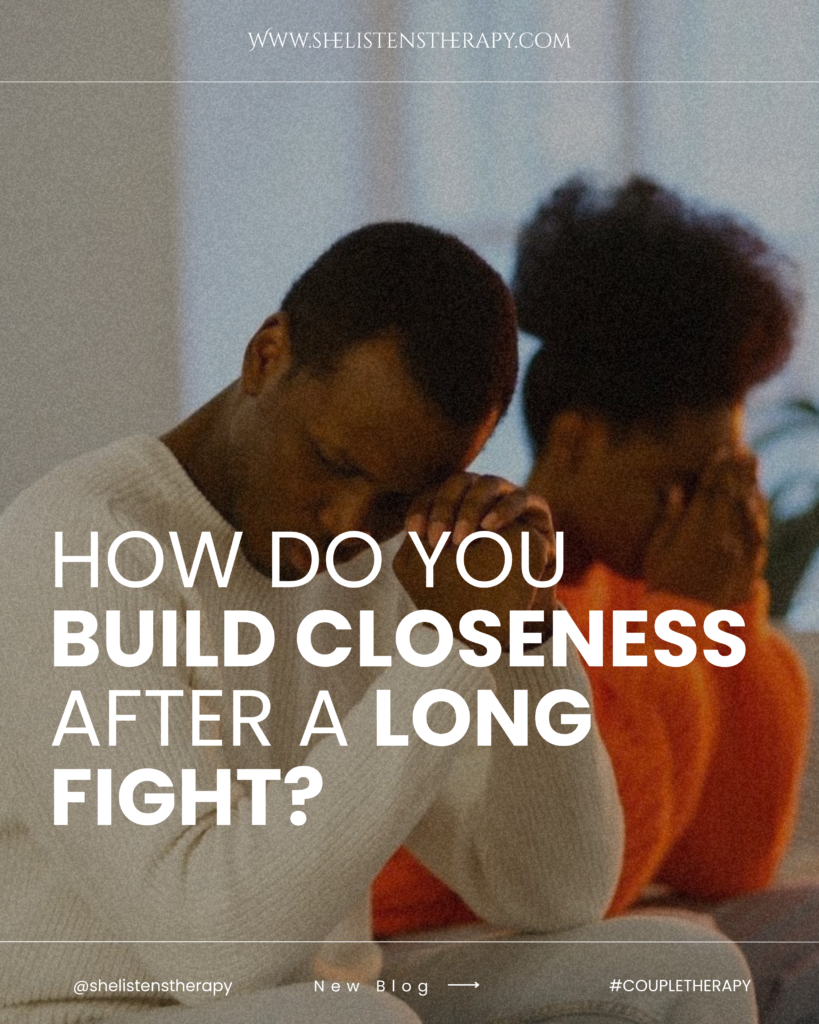
The fight is over. Or at least, it has stopped.
Nobody is shouting anymore. The silence has settled in. However, something still hangs in the air between you. You are in the same space but it does not feel the same. Eye contact feels awkward. You are not sure whether to speak first. Part of you wants to reach for them and part of you is still hurting too much to move.
This is the moment most couples handle badly. Not the fight itself, but the after.
Because many people assume that when the argument ends, the closeness automatically returns. It does not. The end of conflict is not the same as the return of connection. Repair is its own process. And without it, the distance that a fight creates can quietly harden into a wall that becomes harder and harder to climb over.
The good news is that how you come back to each other after a fight matters enormously. In fact, the repair process, when done well, can leave a couple feeling closer than they were before the fight began.
Here are six things that actually help.
1. Give yourself time to fully calm down before reaching for reconnection
Reaching for closeness before you are genuinely calm rarely works. Because if you are still activated, still running the argument in your head, still rehearsing what you should have said, anything your partner does or says will likely land wrong.
Genuine calm is not the same as suppression. Suppression is when you push the feelings down and plaster a smile over them. Calm is when the emotional charge has actually settled and you are able to be present rather than reactive.
For some people, that takes thirty minutes. For others, it takes a few hours. The length of time is not the issue. Moreover, knowing yourself well enough to recognise when you are genuinely ready is what matters.
Going back to your partner before you are ready is not bravery. It is often just a setup for round two. Give yourself the time you actually need. Then move toward them.
2. Lead with acknowledgment, not explanation
When most people attempt to repair after a fight, they lead with their reasoning. They want to explain why they said what they said, clarify what they actually meant, or correct the parts of the argument they feel were misunderstood.
However, explanation before acknowledgment almost always feels like justification to the person still hurting. And justification is not repair. It is continuation.
What actually opens the door is acknowledgment. Not a rehearsed apology. Genuine acknowledgment of the impact. Something as simple as “I know that conversation was really painful. I am sorry for the way I spoke to you” lands completely differently from “I am sorry but here is why I said it.”
Because your partner does not need you to be right more than they need to feel seen. Furthermore, when they feel seen, the wall begins to come down. Explanation can follow acknowledgment. It rarely works the other way around.
3. Reconnect physically before you try to talk everything through
This is one that many couples overlook. They assume repair has to happen through words. However, the body often knows how to repair what the mind is still working through.
A hand on the shoulder. Sitting close enough that your arms are touching. A hug that is held long enough to actually feel like something. These small physical gestures communicate safety in a way that words sometimes cannot.
Touch, when it is welcome and gentle, signals to the nervous system that the threat is over. It says, “We are still okay. We are still us.” That signal can soften a hardened mood more quickly than any perfectly worded apology.
Consequently, before you try to have the full debrief conversation, consider simply being physically near each other first. Watch something together. Sit in the same room without the pressure of resolving everything immediately. Let the warmth return naturally before you attempt to rebuild through words.
4. Have the real conversation, not just the surface one
Once the initial charge has settled and the warmth has begun to return, there is still a conversation that needs to happen. Not the argument itself, because that has passed, but something deeper.
Most fights are not really about what they appear to be about. The argument about who forgot to make the call is often about feeling undervalued. The argument about time is often about feeling like a low priority. The argument about money is often about fear, control, or feeling unheard.
Real repair requires going beneath the surface of what was argued about and getting to what was actually felt. This is the conversation that prevents the same fight from recurring two weeks later.
Ask your partner, “What hurt you most in that conversation?” Then listen without defending. Share what hurt you most. Because when both people feel genuinely heard at that deeper level, the fight loses its power. It becomes something you moved through together rather than something that was done to you.
5. Resist the urge to keep score or revisit the fight repeatedly
Once a genuine repair has happened, let it be repaired. Do not keep returning to the argument to relitigate who was more wrong. Do not bring it up in the next disagreement as evidence. Do not use it as leverage.
Many couples damage their own repair by treating resolution as temporary and conflict as permanent. Every time you bring an old fight back up, you are signalling to your partner that it was never truly resolved, which makes them wonder whether repair is even worth attempting.
In healthy relationships, repair is honoured. When something is worked through, it is put down. It is not carried forward as ammunition.
This does not mean pretending things did not happen. It means trusting that the conversation you had was genuine and allowing the relationship to move forward from that place. Because a relationship where old wounds are constantly reopened never fully heals. It just cycles.
6. Do something intentional to rebuild warmth, not just routine
After a significant fight, going straight back into the logistics of daily life without any intentional reconnection is a missed opportunity. The dishes still need washing and the children still need picking up. However, the relationship also needs something that says, “We are more than the hard things we go through.”
It does not have to be elaborate. A shared meal where both of you are actually present. A walk. A conversation that has nothing to do with problems. Something that reminds you both why you chose each other.
These small intentional moments after a fight are what couples who stay close over the long term do differently. Because closeness is not just the absence of conflict. It is the presence of connection. And connection, especially after rupture, has to be rebuilt deliberately. Research shows that repair attempts are one of the strongest predictors of relationship health
The couples who come back stronger after difficult seasons are not the ones who fight less. In fact, they are the ones who repair better.
Final thoughts
Every relationship has fights. The ones that go long, go deep, and leave both people feeling wrung out and far apart. That is not a sign that something is fundamentally broken. It is a sign that two real people with real emotions are trying to build a shared life.
However, what separates couples who grow closer through conflict from those who grow further apart is not how often they fight. It is how intentionally they return to each other afterward.
Repair is a skill. It can be learned. It can be practiced. And the more you practice it, the more your relationship develops a resilience that difficulty cannot permanently damage.
Because the goal is not a relationship without conflict. The goal is a relationship where both people know, no matter how hard things get, that they will always find their way back to each other.
If you and your partner are finding that the repair process is consistently difficult, working through it with a professional can make an enormous difference. At Shelistens Therapy and Consulting, that is exactly the kind of work we do.
Visit shelistenstherapy.com or send a message on WhatsApp to 0802 991 1256 to book a session.